
Transaction termite report, the WDIIR
The Arizona termite report your lender asks for
A termite inspection for a real estate transaction produces a wood-destroying insect inspection report (WDIIR), a signed document Arizona lenders often require before closing. It records the visible evidence of wood-destroying insects and the conditions that invite them, found on the day of inspection in the areas that can be reached.
- Signed by a licensed certified applicator
- One visit with your home inspection
- AZHI refers treatment out
Read the document
The report your lender receives, section by section
A WDIIR is a specific state form, not a generic letter. Knowing how it is laid out tells you exactly what it does, and does not, claim.
Arizona Wood-Destroying Insect Inspection Report (WDIIR)
- 1
The structure diagram
A sketch of the building that locates what was found and where the inspector could and could not reach.
- 2
The findings
Visible evidence of wood-destroying insects, recorded as current or previous activity where that can be told apart.
- 3
Obstructions and inaccessible areas
What could not be seen on the day, recorded as an obstruction rather than guessed at: stored belongings, coverings, a sealed attic or subarea.
- 4
Conducive conditions and recommendations
The situations that invite insects, such as earth-to-wood contact or moisture, and the recommended next steps.
The distinction people misread
Evidence of activity is not a conducive condition
A report can note conditions that invite insects with no evidence of a single insect. Telling the two apart is the whole point of reading it well.
Evidence of activity
Signs an insect was actually there
- Mud or shelter tubes on the foundation
- Live or dead insects, or discarded wings
- Frass or pellet piles below wood
- Exit holes and visibly insect-damaged wood
- Marked as current or previous where it can be told
Conducive conditions
Situations that invite them in
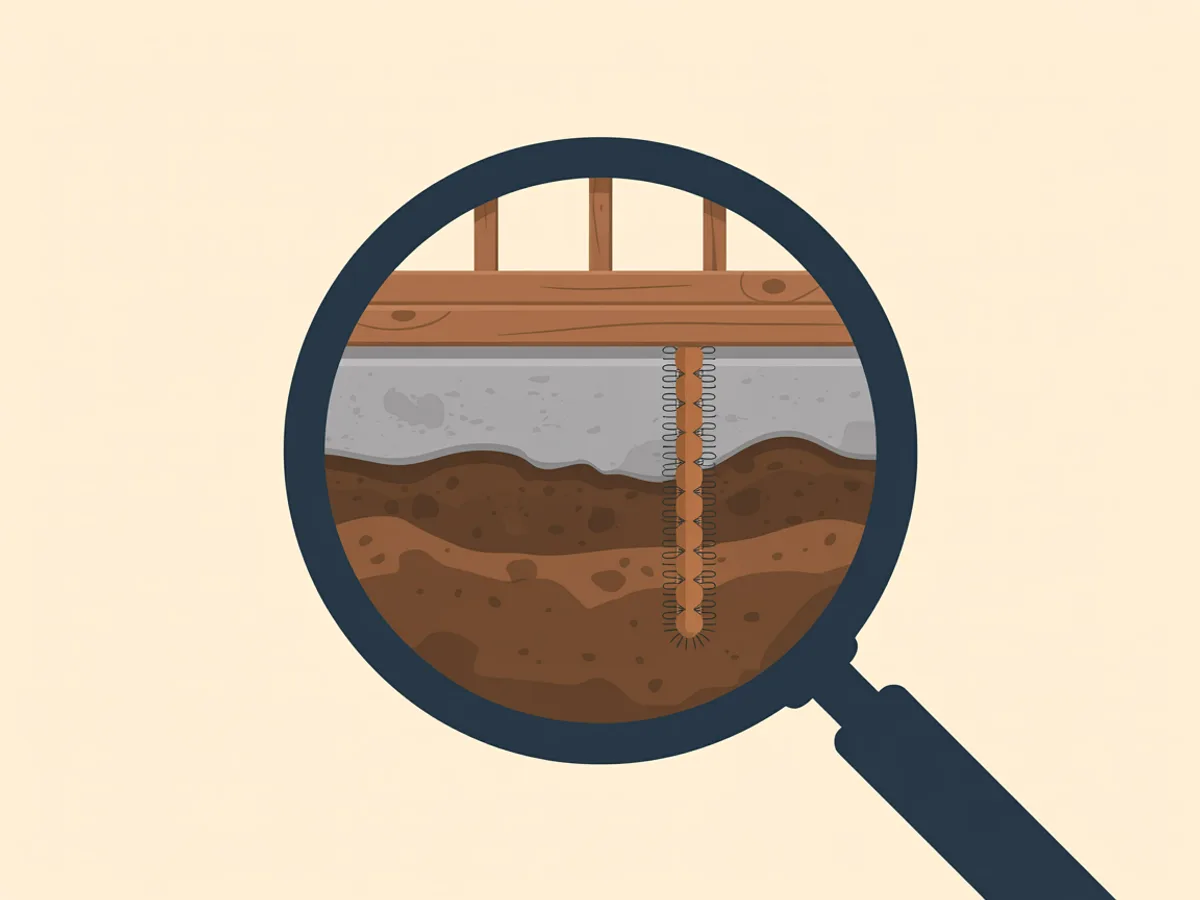
- Earth-to-wood contact at the structure
- Excess moisture and poor drainage
- Faulty grade against the building
- Cellulose debris or scrap wood at the base
- Form boards left in place after construction
Scope
The areas the report can reach
Foundation and exterior perimeter
The accessible base of the structure, exterior wood trim and posts, and grade where soil meets the building, examined for shelter tubes, damaged wood, and earth-to-wood contact.
Accessible interior
Reachable baseboards, door and window frames, closets, and under-sink cabinets, examined for visible evidence of wood-destroying insects and moisture.
Garage
Accessible framing, the wall shared with living space, and any earth-to-wood contact around the slab and door frame.
Accessible attic
Visible framing and sheathing viewed from accessible points, where entry and clearance allow, for evidence of activity or wood decay.
Accessible subarea or crawlspace
Where a home has one and it can be entered safely, the substructure wood is examined; most Phoenix slab-on-grade homes have no crawlspace, which the report notes.
Visible evidence of activity
Mud or shelter tubes, live or dead insects, frass or pellets, exit holes, and wood showing insect damage, recorded as current or previous where distinguishable.
Conducive conditions
Earth-to-wood contact, excess moisture, faulty grade and drainage, cellulose debris or wood scraps against the structure, and form boards left in place, which invite insects but are not themselves evidence of infestation.
A visual, non-destructive report
What a WDIIR can document, and what stays out of reach
What the report documents
- Visible evidence in the areas reached on the day
- Conducive conditions that invite wood-destroying insects
- Obstructions and inaccessible areas, recorded on the form
- Recommendations, with treatment referred to a licensed company
What stays out of reach
- Infestation concealed in a wall cavity or under a slab
- Anything behind stored belongings, finishes or insulation
- A guarantee the home is or will stay insect-free
- Structural damage assessment or a treatment bid
Know the culprits
The desert wood-destroyers, and how they show themselves
Subterranean termites
Mud or shelter tubes climbing the foundation and earth-to-wood contact.
Drywood termites
Small piles of hard six-sided pellets (frass) below infested wood.
Wood-boring beetles
Round or oval exit holes and powdery frass in framing and trim.
Carpenter ants
Smooth galleries and coarse sawdust where wood stays damp.
Wood-decay fungus
Softened, discolored or crumbling wood driven by a moisture problem.
The honest licensing chain
AZHI inspects. A licensed applicator signs the WDIIR.
- 1
AZHI performs the inspection
Scheduled on the same visit as your home inspection, so you coordinate one appointment.
- 2
A certified applicator signs the report
Working under a licensed Arizona pest-control business, they complete and sign the WDIIR. The specific credentials are confirmed at booking.
- 3
The signed report goes to your lender
Provided for you and your lender or escrow. AZHI is not a pest-control company and sells no treatment.
Order it once, alongside your home inspection
The WDIIR can be scheduled on the same visit as the AZHI home inspection, so you coordinate a single appointment. It is a distinct certified report with its own scope, not a section of the home inspection, and any treatment it recommends is referred out to a licensed pest-control company and quoted separately.
Common questions
Termite and WDIIR questions we get asked
Do I need a termite inspection to buy a home in Arizona?
Often yes, because the lender asks for it. A wood-destroying insect inspection report (WDIIR) is commonly required by Arizona lenders as a condition of the loan, especially on government-backed financing. It is not a state law requirement for every purchase, so confirm with your lender or agent whether your specific transaction needs one.
Who is licensed to perform and sign the WDIIR?
In Arizona a WDIIR must be completed and signed by a certified applicator working under a licensed Arizona pest-control business. AZHI coordinates the WDIIR alongside your home inspection so it happens in one visit, and the specific certified-applicator and pest-control-business credentials that sign your report are confirmed at booking. AZHI performs the home inspection and is not itself a pest-control company.
What is the difference between evidence of termites and conducive conditions?
Evidence of activity means physical signs of wood-destroying insects were seen, such as mud tubes, frass, damaged wood, or live insects, and the report marks it as current or previous where that can be told. Conducive conditions are situations that invite insects, such as earth-to-wood contact or excess moisture, but are not proof that insects are present. A report can note conducive conditions with no evidence of activity at all.
Does the report cover the whole house?
It covers the areas that can be seen and safely reached on the day of inspection. It is a visual, non-destructive inspection, so spaces blocked by stored belongings, wall or floor coverings, insulation, or an inaccessible attic or subarea are recorded as obstructions rather than guessed at. Absence of visible evidence is not a guarantee that no insects are present.
Can the termite report be done with my home inspection?
Yes. The WDIIR can be scheduled on the same visit as the AZHI home inspection so you coordinate a single appointment. It is a separate certified report with its own scope, not a section of the home inspection.
If termites are found, will you treat them?
No. The WDIIR reports findings only. AZHI does not sell treatment; any treatment is referred out to a licensed pest-control company and quoted separately, so the inspection and the report stay independent of any treatment recommendation.
Where this fits
Booked alongside these
Where we work
WDIIR across the Valley
- Scottsdale
- Tempe
- Mesa
- Chandler
- Gilbert
- Glendale
- Peoria
- Avondale
- Goodyear
- Buckeye
- Verrado
- Litchfield Park
- Tolleson
- El Mirage
- Surprise
- Waddell
- Youngtown
- Cave Creek
- Carefree
- Anthem
- New River
- Rio Verde
- Fountain Hills
- Paradise Valley
- Queen Creek
- San Tan Valley
- Apache Junction
- Gold Canyon
- Florence
- Casa Grande
- Maricopa
- Coolidge
- Sun City
- Sun City West
- Sun Lakes
Bob was very thorough and showed us all issues that need correcting. I was impressed with his knowledge and comfortable demeanor. I would definitely hire his services again.
Book it
Get a quote for the WDIIR with your inspection
Send the property details and you get a written quote and the next available dates back.