
Buying a House With Solar Panels in Phoenix: What to Check
Buying a house with solar panels in Phoenix? An SPRK Solar Certified inspector explains owned vs leased systems, APS and SRP rates, and what to inspect.
Bob ClardyOctober 2, 202611 min read
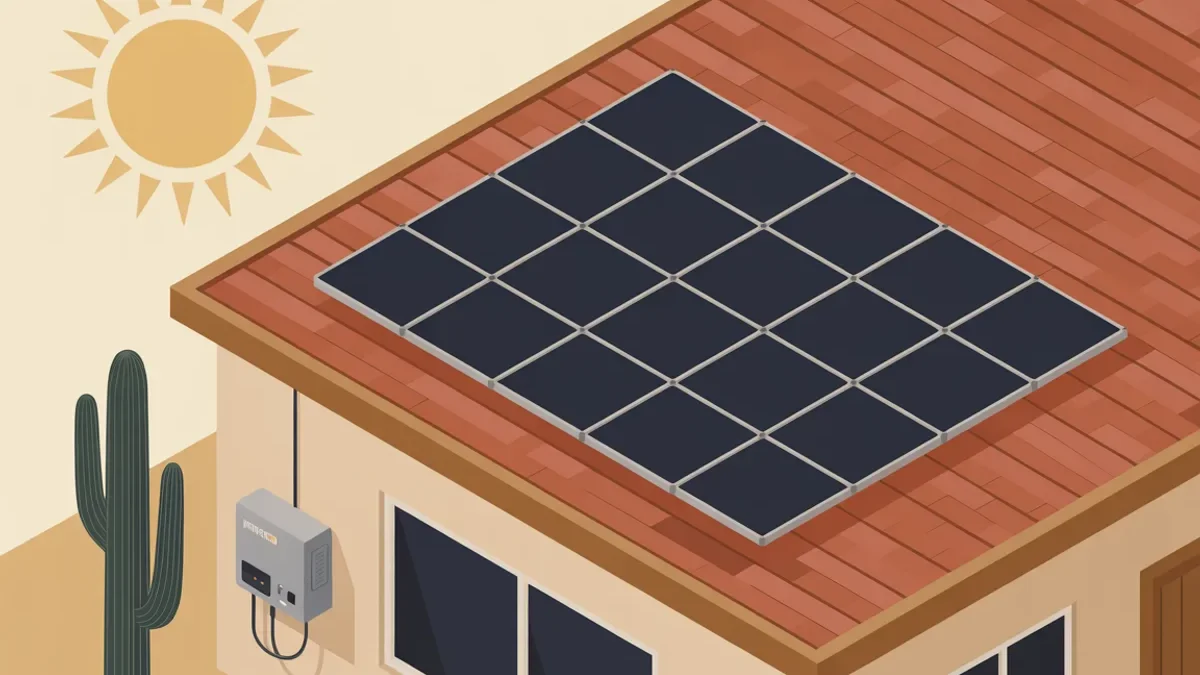
When buying a house with solar panels, check three things before you close: who owns the system, what condition it is in, and what the utility will credit you for the power it exports. Get the ownership papers from the seller, a solar inspection from a certified inspector, and a recent electric bill.
Those three answers are the difference between a genuinely good deal and an expensive surprise. An owned system transfers with the house. A leased or financed system comes with a contract, an approval process, and often a filing on title that has to be cleared. And whoever owns it, the panels, roof mounts, wiring, and inverter have been baking in Arizona sun for years. Here is how to sort all of it out before your inspection period runs out.
Is buying a house with solar panels a good idea in Arizona?
It can be. Few places put solar to work like the Valley, and a healthy, owned system can take a real bite out of summer electric bills. But "the house has solar" is not a feature on its own. It is a piece of equipment with an owner, an age, a condition, and a set of contracts attached, and each of those can work for you or against you.
A few things are worth knowing up front:
- A leased system is a monthly payment you are agreeing to take over, not an asset you are buying.
- A financed system that is not paid off has to be dealt with at closing, usually from the seller's proceeds.
- Inverters wear out sooner than panels. A system that was installed a decade ago may be approaching an inverter replacement even while the panels keep producing.
- Arizona does not tax the added value. Under A.R.S. 42-11054, solar energy devices and grid-tied photovoltaic systems designed primarily for on-site use are considered to add no value to the property for property tax purposes.
Do solar panels increase home value?
They can, but it depends on who owns them. An owned system in good condition is part of the house you are buying, and lower electric bills are a real benefit. A leased system belongs to the solar company, so it is not part of what you are buying, and appraisals generally leave leased equipment out of a home's value. Condition matters too: an aging inverter or a leaking roof mount takes value away. The Arizona tax rule above is about property taxes, not about what a buyer will pay.
None of that is a reason to pass on a good house. It is a reason to ask better questions, sooner.
Owned, financed, or leased: find out first
Ownership drives almost everything else, so it is the first question to put to the seller and the listing agent. Here is how the three common arrangements compare when you are the buyer:
| Owned outright | Financed (solar loan) | Leased or PPA | |
|---|---|---|---|
| Who owns the equipment | The seller, then you | The seller, with a lender's security interest | The solar company |
| What usually happens at closing | It transfers with the house | The loan is paid off and the lender's filing is released | You apply to take over the contract, or the seller buys it out |
| Payment after you move in | None | None, once paid off | Yes, for the rest of the term |
| Filing on title to clear | Usually none | Often a UCC-1 fixture filing | Often a UCC-1 fixture filing |
| Paperwork to request | Purchase records, warranties, permits, utility interconnection approval | Payoff letter and written release of the filing | The full lease or PPA, payment and escalator schedule, remaining term, buyout quote |
If you are writing an offer in Arizona, ask your agent about the Arizona REALTORS® Solar Addendum. Since its 2022 revision it applies whether the system is leased, financed, or owned outright, which makes it a useful structure for getting the right documents on the table early.
Buying a house with leased solar panels
A lease or power purchase agreement (PPA) is a contract between the seller and a solar company. The panels on the roof belong to that company, and you are not buying them with the house. To keep them, you take over the contract for its remaining term, and the solar company has to approve you first, typically including a credit review. Transfers can take weeks, so the application should go in as soon as you are under contract, not the week before closing.
Before you agree to take over a lease, read the actual contract and look for:
- The monthly payment, and whether it escalates each year, and by how much.
- How many years are left and what happens at the end of the term.
- Who is responsible for repairs, monitoring, and inverter replacement.
- What happens if the roof needs work. Removing and reinstalling an array for a roof repair is real money, and the contract should say who pays.
- The buyout price, even if you plan to assume the lease. It is useful leverage in a negotiation.
One more thing buyers miss: a lease may cover the equipment, but it does not cover your house. If a roof penetration under the array starts leaking, the water damage is yours. That is exactly why the physical condition of a leased system still matters.
Buying a house with solar panels that are not paid off
A solar loan is usually secured by the equipment, and lenders commonly record a UCC-1 fixture filing to protect that interest. Your title company will find it, and your mortgage lender will generally want it paid off and released (or subordinated) before funding, because your mortgage needs to sit in first position.
In practice, that means:
- Ask early whether there is a solar loan and who holds it.
- Make sure the payoff is in the escrow instructions, paid from the seller's proceeds.
- Get written confirmation that the filing has been released, and keep it with your closing documents.
If a seller tells you the panels are "paid for," it is still worth asking title to confirm there is no filing against them.
Does the solar rate transfer with the house in Phoenix?
This one surprises people, and it varies by utility. The value of a system depends partly on what the utility credits you for the excess power you export, and that rate is not the same for every home.
APS. Under APS's Resource Comparison Proxy export rate rider, a system's export credit is set by the yearly "tranche" in effect when its interconnection application went in, and that rate is locked for the first 10 years. The tariff also says a customer who moves into a site already served under the rider may continue with the same tranche. That makes the installation date worth knowing: the 2018 tranche credits $0.11610 per kWh, while the 2026 tranche, which started September 1, 2026, credits $0.05554 per kWh.
SRP. SRP's interconnection agreement requires the seller to tell a buyer that, to interconnect and receive any buyback benefits, the buyer must sign SRP's then-current version of the agreement. You will also choose from SRP's current solar price plans when you open your account.
Either way, ask the seller for a recent electric bill and the date the system was approved for interconnection. Those two documents tell you more about the system's real-world value than any sales brochure.
What a solar inspection checks before you buy
The paperwork tells you who owns the system. A solar inspection tells you what shape it is in. At AZ Home Inspection Services, the solar evaluation is added to your home inspection and covered on the same visit. Here is what our team looks at:
- Panels and modules: cracked or clouded glass, delamination, discoloration, hot-spot staining, heavy soiling, and loose modules.
- Mounting, racking, and roof penetrations: how the array attaches and the flashing where mounts pass through the roof, a common leak point on the tile and foam roofs found across the Phoenix area.
- Wiring, conduit, and connectors: sun-brittled insulation, corrosion, loose connections, and the rodent and bird damage that is common under desert rooftop arrays.
- Inverter or microinverters: the type, visible condition, any fault indicators, and whether it appears near the end of its typical service life.
- Disconnects and rapid-shutdown equipment: present and in accessible condition.
- Battery storage, when present: its presence and visible physical condition.
- Monitoring and records: whether production monitoring is present and reporting, and which documents to request from the seller.
Arizona heat is the reason this matters more here. Exposed solar components simply age faster under months of triple-digit sun than they would in a milder climate.
It is also worth being clear about what an inspection is not. It is not a metered production test logged over days or seasons, it does not settle the terms of a loan, lease, or PPA, it is not an engineering study or a roof certification, and it is not a warranty. It is a careful, documented look at the condition of the system you are about to own.
What the SPRK Solar Inspection Report shows
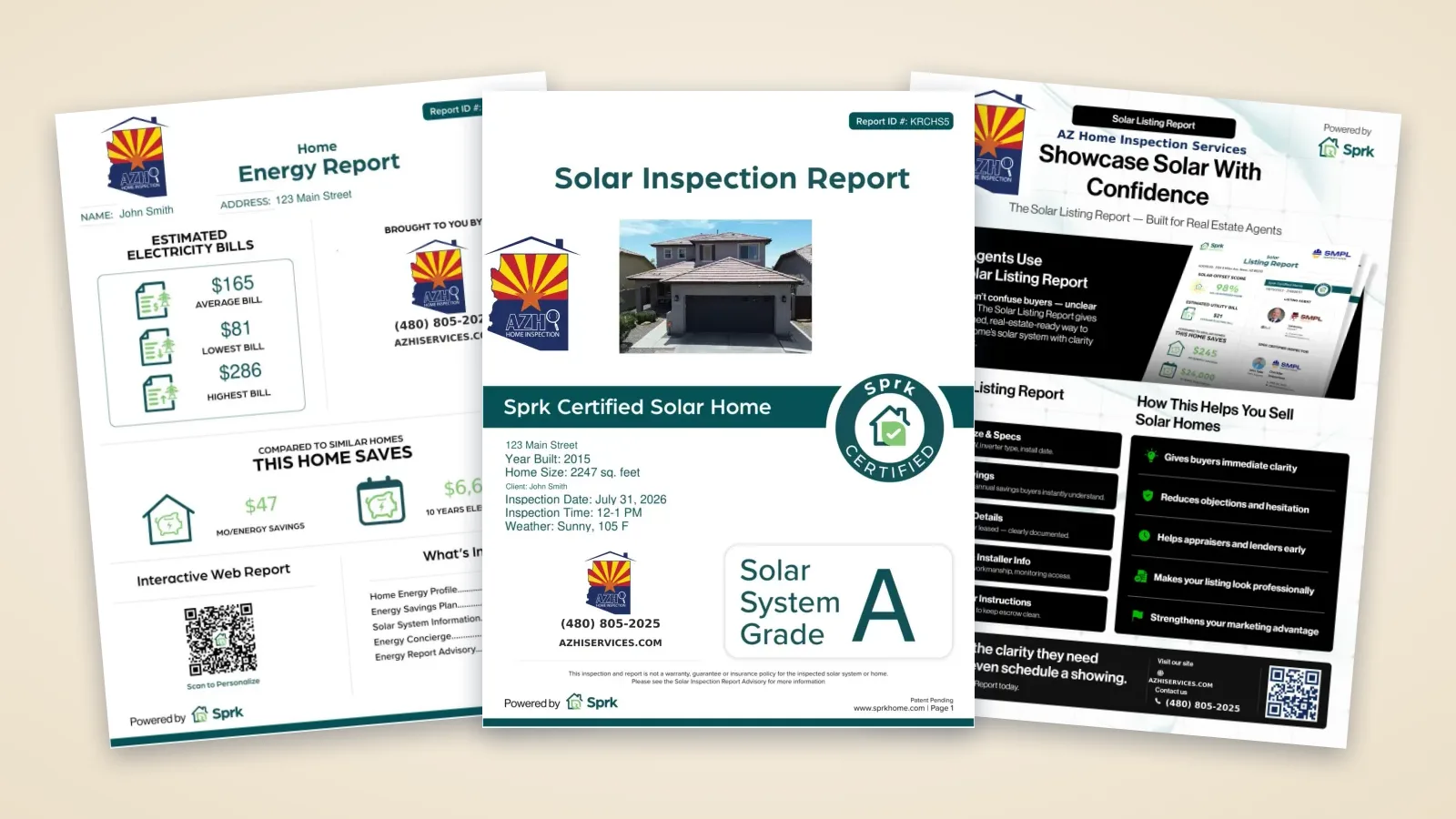
Founder Bob Clardy and lead inspector Stephen Lafakis are both SPRK Solar Certified Inspectors, and AZHI's solar findings are delivered in reports powered by SPRK, a platform built around solar homes in real estate. There are three, one for each side of a solar sale:
- Solar Inspection Report (for buyers). A letter grade for the whole solar system on the cover, so the overall picture reads before the detail does, along with the property details, inspection date, time, and weather, and the photo-documented findings inside.
- Home Energy Report (for homeowners and buyers). Estimated average, lowest, and highest monthly electric bills, monthly and 10-year savings compared with similar homes, and an interactive web report with an energy savings plan and the solar system information.
- Solar Listing Report (for sellers and listing agents). System size and specs, estimated monthly and annual savings, whether the system is owned, loaned, or leased, warranty and installer details, monitoring access, and the steps for transferring the system.
You can see full-size versions of all three on our solar inspection page.
Questions to ask the seller before you close
Print this list or forward it to your agent:
- Is the system owned outright, financed, leased, or on a PPA?
- If leased or on a PPA: may I see the full contract, the current payment, the escalator, the remaining term, and a buyout quote?
- If financed: who holds the loan, and will it be paid off at closing?
- Is there a UCC-1 filing on the property for the solar equipment?
- When was the system installed, and when was it approved for interconnection by APS or SRP?
- Can you share a year of electric bills?
- What warranties remain on the panels, the inverter, and the installation workmanship, and do they transfer?
- Has the array ever been removed for roof work, and was the roof under it repaired or replaced?
- Is there a monitoring app or account, and will you transfer access?
- Has the inverter ever been replaced or thrown fault codes?
Bought a house with solar panels? What to do next
Congratulations, now make it yours on paper as well as on the deed:
- Take over the monitoring account so you can see production from day one, and notice quickly if it drops.
- Confirm the utility side. Make sure your electric account is set up on the right solar plan and any interconnection paperwork is signed.
- Register warranty transfers with the panel and inverter manufacturers or the installer, if the warranty requires it.
- Keep your inspection report as the baseline. If something changes later, you have a dated, photographed record of the system's condition when you bought it.
- Learn where the disconnects are, so you know how to shut the system down if a roofer, electrician, or emergency crew asks.
Talk to a solar certified inspector in the Valley
Bob Clardy has been inspecting homes in the Valley since 2005, and he and lead inspector Stephen Lafakis both hold the SPRK solar certification. If you are buying a home with solar, add the solar evaluation when you book your inspection and you will get the system graded, photographed, and explained in plain language. Listing a home with solar? The Solar Listing Report helps buyers understand the system before they ever schedule a showing.
See the sample SPRK reports, book your inspection, or call 480-805-2025 and tell us about the system on the roof.
Sources
- A.R.S. 42-11054, Standard appraisal methods and techniques
- APS Rate Rider RCP, Resource Comparison Proxy export rate
- SRP Distribution Interconnection Agreement (sample)
- SRP solar price plans
- Arizona REALTORS Solar Addendum FAQs
About the author
Bob Clardy, Founder & Owner, AZ Home Inspection Services
Bob Clardy founded AZ Home Inspection Services in 2005, the same year he became a licensed home inspector, and has lived in the Valley of the Sun for more than 50 years. He is an ASHI Certified Inspector, licensed by the Arizona Board of Technical Registration, BPI Certified, Background Verified, Pool & Spa Certified, and an SPRK Solar Certified Inspector.

Need an inspection in the Valley?
The AZ Home Inspection Services team has performed thousands of inspections across the Phoenix metro. Residential inspections start at $325, and your photo-rich digital report is typically delivered the same day.
Frequently asked
Should I get a solar inspection when buying a house with solar panels?
Yes, if you are taking on a system you have not seen evaluated. A standard home inspection does not include a detailed look at the panels, roof mounts, wiring, and inverter. At AZ Home Inspection Services the solar evaluation is an add-on covered on the same visit, and the findings come back in an SPRK Solar Inspection Report with a letter grade for the whole system on its cover.
Can I take over a solar lease when I buy a house in Arizona?
Usually, if the solar company approves you, which typically includes a credit review. Transfers can take weeks, so apply as soon as you are under contract. The other common path is for the seller to buy out the lease before closing. Ask your agent about the Arizona REALTORS Solar Addendum to put the terms in writing.
What happens if the solar panels on a house are not paid off?
A solar loan is usually secured by the equipment, often with a UCC-1 fixture filing. Your title company will find it, and your mortgage lender will generally want it paid off and released, or subordinated, before funding. The payoff normally comes from the seller's proceeds at closing.
Do solar panels raise property taxes in Arizona?
Under A.R.S. 42-11054, solar energy devices and grid-tied photovoltaic systems designed primarily for on-site consumption are considered to add no value to the property they are installed on. Check with your county assessor for anything specific to your property.
Does the APS solar export rate transfer to a new owner?
Under the APS Resource Comparison Proxy rider, a customer who moves into a site already served under the rider may continue with the same rate tranche, which is locked for the first 10 years. In SRP territory, the buyer signs SRP's current interconnection agreement and chooses a solar price plan.
Who inspects solar systems at AZ Home Inspection Services?
Founder Bob Clardy and lead inspector Stephen Lafakis are both SPRK Solar Certified Inspectors, and the AZHI team performs complete solar system evaluations across the Phoenix metro. Call 480-805-2025 to add one to your inspection.
- buying a home
- solar panels
- solar inspection
- leased solar
- Phoenix
Educational resources provided by AZ Home Inspection Services are intended for general homeowner information and do not replace a property-specific inspection, specialist evaluation or qualified contractor advice when appropriate.